5 Informed Search
Informed search strategies
- Informed (heuristic) search strategies
- Use problem-specific knowledge beyond the definition of the problem itself.
- Can find solutions more efficiently than an uninformed strategy.
What is a heuristic?
- Additional knowledge of the problem imparted to the search algorithm.
- A heuristic estimates how close a state is to a goal.
5.1 Best-first search
Best-first search
- An instance of the general tree/graph search algorithm.
- A node is selected for expansion based on an evaluation function, f(n), which is construed as a cost estimate.
- The node with the lowest evaluation f(n) is expanded first.
- The implementation of best-first graph search is identical to that for uniform-cost search, except for the use of f instead of g to order the priority queue.
- The choice of f determines the search strategy.
- Most best-first algorithms include as a component of f a heuristic function, denoted h(n):
- h(n): estimated cost of the cheapest path from the state at node n to a goal state.
- h(n) depends only on the state at node n.
- Assumption of h:
- Arbitrary, nonnegative, problem-specific functions.
- Constraint: if n is a goal node, then h(n)=0.
5.2 Greedy best-first search
Greedy best-first search
- Attempts to expand the node that is closest to the goal, on the grounds that this is likely to lead to a solution quickly.
- Thus, it evaluates nodes by using just the heuristic function: f(n)=h(n)
Illustration: Romania
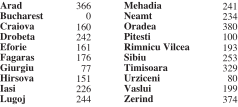
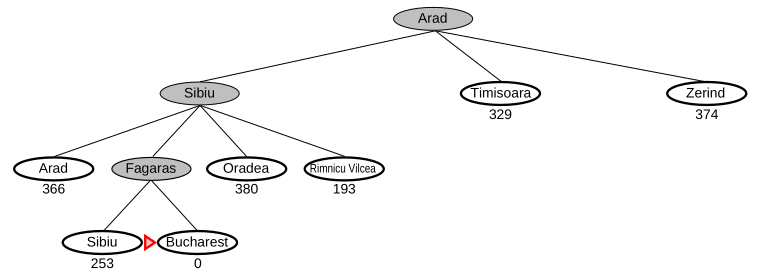
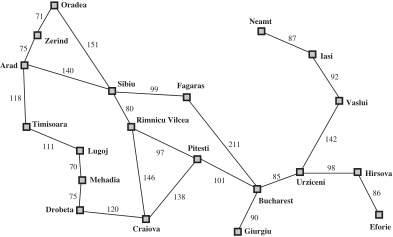
Use the straight-line distance heuristic, which we will call h_{SLD}.
Table: Values of h_{SLD} – straight-line distances to Bucharest.
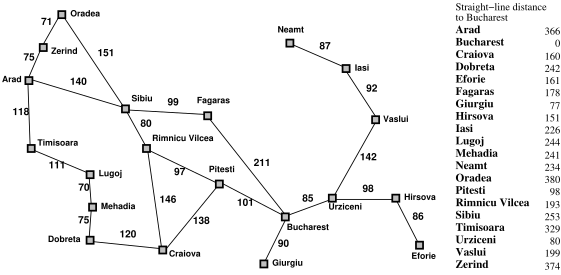
The initial state:

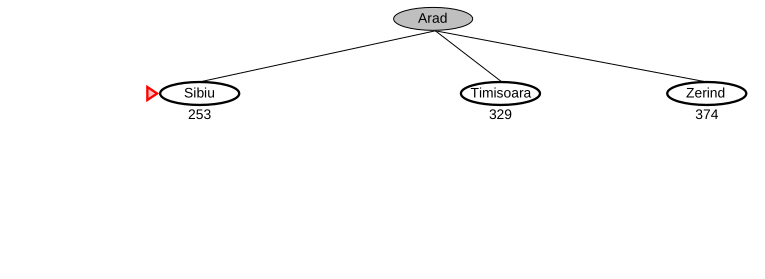
After expanding Arad:
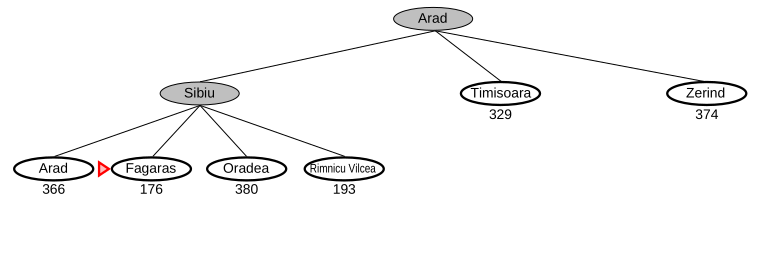
After expanding Sibu:
After expanding Fagaras:
Properties
- Time: O(b^{m}), but a good heuristic can give dramatic improvement.
- Space: O(b^{m}), keeps all nodes in memory.
- Complete: No, can get stuck in loops (e.g., Iasi \rightarrow Neamt \rightarrow Iasi \rightarrow Neamt \rightarrow …).
- Yes in finite space with repeated-state checking.
- Optimal: No.
5.3 A* search
A* search
- A* search (pronounced A-star search) is the most widely known form of best-first search.
- Ideas:
- Use heuristic to guide search, but not exclusively.
- Avoid expanding paths that are already expensive.
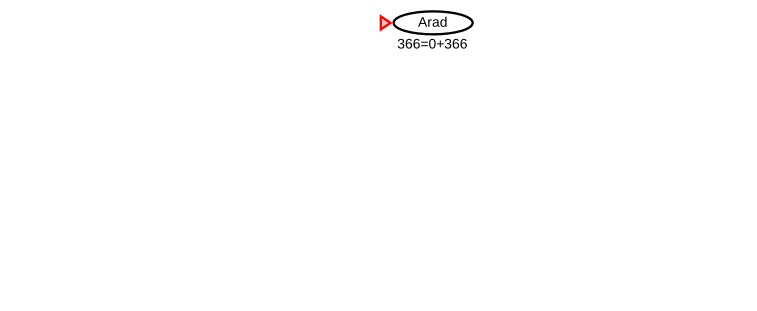
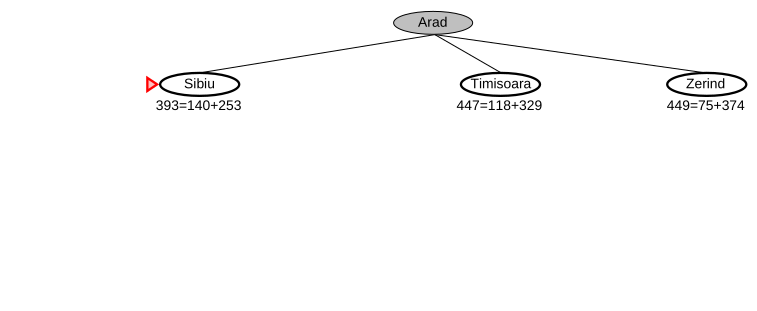
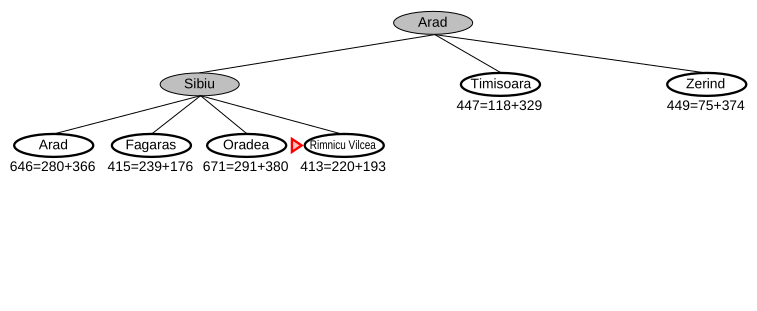
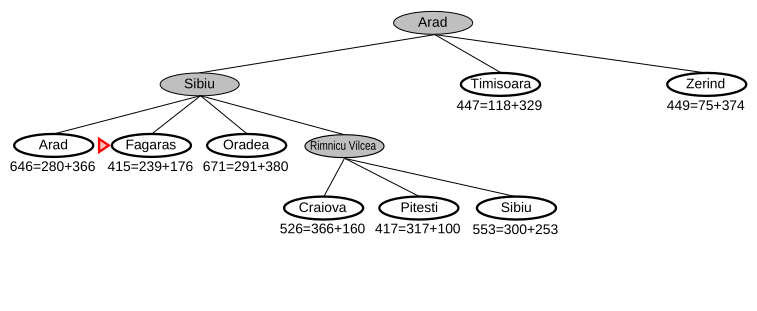
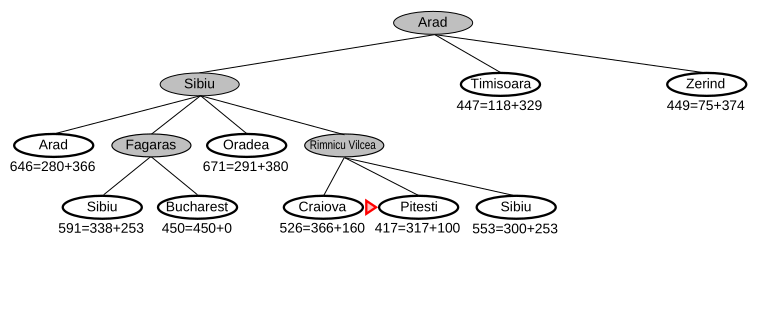
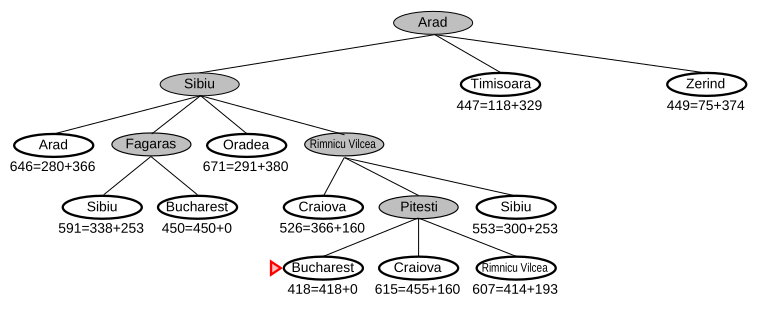
- Evaluation function: f(n)=g(n)+h(n)
- g(n): cost so far to reach n.
- h(n): estimated cost of the cheapest path to goal from n.
- f(n): estimated cost of the cheapest solution through n.
- The algorithm is identical to Uniform-Cost-Search except that A* uses g+h instead of g.
Illustration: Romania
Properties
- Time: Exponential in [relative error in h \times length of solution].
- Space: Keeps all nodes in memory.
- Complete: Yes, unless there are infinitely many nodes with f\leq f(G).
- Optimal: Yes, cannot expand f_{i+1} until f_{i} is finished.
- A* expands all nodes with f(n)<C^{*}.
- A* expands some nodes with f(n)=C^{*}.
- A* expands no nodes with f(n)>C^{*}.
Admissibility and Consistency
Definition
h(n) is an admissible heuristic:
- if it never overestimates the cost to reach the goal,
- or if for every node n, h(n)\leq h^{*}(n) (where h^{*}(n) is the true optimal cost to reach the goal state from n).
Definition
h(n) is a consistent heuristic if, for every node n and every successor n' of n generated by any action a, the estimated cost of reaching the goal from n is no greater than the step cost of getting to n' plus the estimated cost of reaching the goal from n’: h(n)\leq c(n,a,n')+h(n')
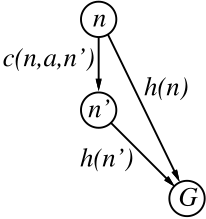
- A consistent heuristic is also admissible.
Optimal for A*
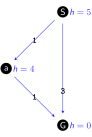
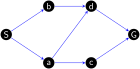
Using tree search algorithm to find a path from S to G:
Theorem
The tree-search version of A* is optimal if h(n) is admissible.
Proof
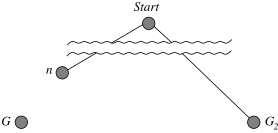
Suppose some suboptimal goal G_{2} has been generated and is in the frontier. Let n be an unexpanded node on a shortest path to an optimal goal G (graph separation).
- f(G)=g(G) since h(G)=0.
- f(G_{2})=g(G_{2}) since h(G_{2})=0.
- g(G_{2})>g(G) since G_{2} is suboptimal.
- f(G)>f(n) since h is admissible.
- Since f(G_{2})>f(n), A* will never select G_{2} for expansion.
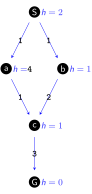
- Using graph search algorithm to find a path from S to G:
Theorem
The graph-search version of A* is optimal if h(n) is consistent.
Proof
If h(n) is consistent, then the values of f(n) along any path are nondecreasing. Suppose n' is a successor of n; then g(n')=g(n)+c(n,a,n') for some action a, and we have: f(n')=g(n')+h(n')=g(n)+c(n,a,n)+h(n')\geq g(n)+h(n)=f(n)
Whenever A* selects a node n for expansion, the optimal path to that node has been found. Were this not the case, there would have to be another frontier node n' on the optimal path from the start node to n; since f(n')<f(n), n' would have been selected first.
Contours
The search algorithm expands nodes in order of increasing f value.
We can draw contours in the state space, just like the contours in a topographic map.
- Gradually adds f-contours of nodes; contour i has all nodes with f<f_{i}, where f_{i}<f_{i+1}.
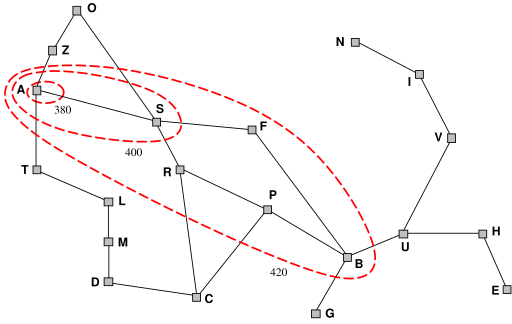
The bands of uniform-cost search will be “circular” around the start state.
The bands of A* with more accurate heuristics will stretch toward the goal state and become more narrowly focused around the optimal path.
The 8-puzzle
The average solution cost for a randomly generated 8-puzzle instance is about 22 steps.
The branching factor b is about 3.
8-puzzle:
- 3^{22}\approx 3.1\times 10^{10} states (using an exhaustive tree search).
- 9!/2=181,440 reachable states (using graph search).
15-puzzle: around 10^{13} states.
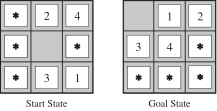
A typical instance of the 8-puzzle. The optimal solution is 26 steps long.
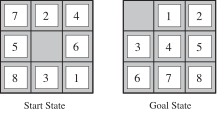
Admissible heuristics for 8-puzzle
h_{1} = the number of misplaced tiles. h_{1} is an admissible heuristic because it is clear that any tile that is out of place must be moved at least once.
h_{2} = the sum of the distances of the tiles from their goal positions. h_{2} is also admissible because any move can only move one tile one step closer to the goal.
h_{1}=1+1+1+1+1+1+1+1=8 and h_{2}=3+1+2+2+2+3+3+2=18.
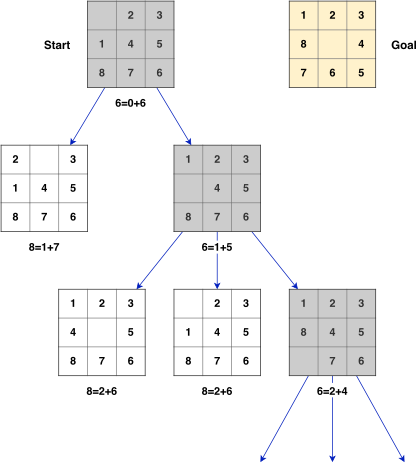
Solve 8 puzzle
Using h_{2}:
5.4 Memory-bounded heuristic search
Memory-bound heuristic search
- In practice, A* usually runs out of space long before it runs out of time.
- Idea: Try something like DFS, but do not forget everything about the branches we have partially explored.
Iterative-deepening A* (IDA*)
- The main difference with IDS:
- Cut-off uses the f-value (g+h) rather than the depth.
- At each iteration, the cutoff value is the smallest f-value of any node that exceeded the cutoff on the previous iteration.
- Avoids the substantial overhead associated with keeping a sorted queue of nodes.
- Practical for many problems with unit step costs, yet difficult with real valued costs.
Algorithm
function IDA*(problem) returns a solution, or failure

  variables:
    f_limit: the current f-COST limit
    root: a node

    root ← Make-Node(problem.Initial-State)
    f_limit ← root.f

    loop do
      solution, f_limit ← DFS-Contour(problem, root, f_limit)
      if solution is non-null then return solution
      if f_limit = ∞ then return failure
function DFS-Contour(problem, node, f_limit) returns a solution, or failure, a new f-cost limit
if node.f > f_limit then return null, node.f
if problem.Goal-Test(node.State) then return Solution(node)
successors ← ⌀
for each action in problem.Actions(node.State) do
add Child-Node(problem, node, action) into successors
f_next ← ∞
for each s in successors do
solution, f_new ← DFS-Contour(problem, s, f_limit)
if solution is non-null then return solution, f_limit
f_next ← Min(f_next, f_new)
return null, f_nextIllustration
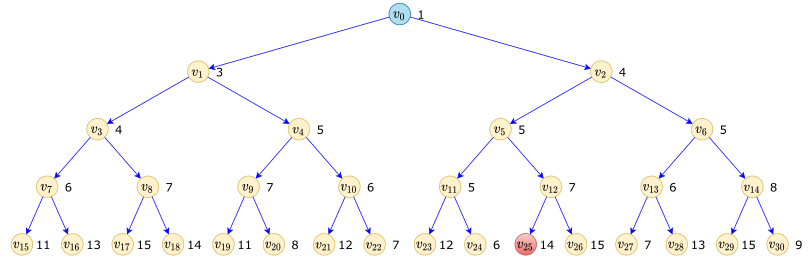
- IDA* search for the shortest route from v_{0} (start node) to v_{25} (goal node); each node has a f value.
Recursive best-first search (RBFS)
- Keeps track of the f-value of the best alternative path available from any ancestor of the current node.
- Backtracks when the current node exceeds f\_limit.
- As it backtracks, it replaces the f-value of each node along the path with the best value f(n) of its children.
Algorithm
function Recursive-Best-First-Search(problem) returns a solution, or failure

  return Rbfs(problem, Make-Node(problem.Initial-State), ∞)

function Rbfs(problem, node, f_limit) returns a solution, or failure and a new f-cost limit

  if problem.Goal-Test(node.State) then return Solution(node)
  successors ← ⌀
  for each action in problem.Actions(node.State) do
    add Child-Node(problem, node, action) into successors
  if successors is empty then return failure, ∞
  for each s in successors do
    // update f with value from previous search, if any
    s.f ← Max(s.g + s.h, node.f)
  loop do
    best ← lowest f-value node in successors
    if best.f > f_limit then return failure, best.f
    alternative ← the second-lowest f-value among successors
    result, best.f ← Rbfs(problem, best, Min(f_limit, alternative))
    if result != failure then return result
Illustration
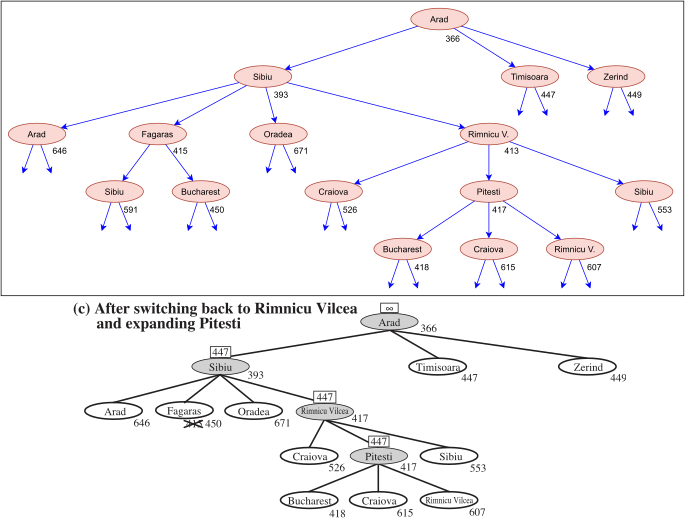
- Stages in an RBFS search for the shortest route to Bucharest. The f-limit value for each recursive call is shown on top of each current node, and every node is labeled with its f-cost.
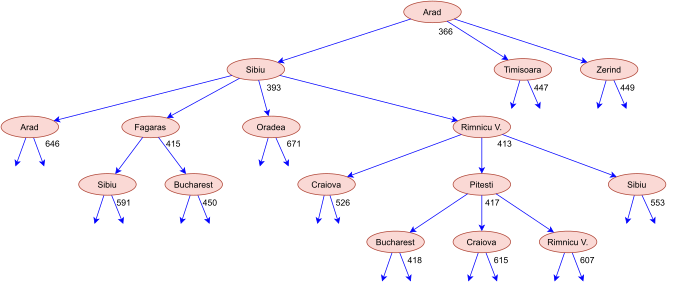
- The path via Rimnicu Vilcea is followed until the current best leaf (Pitesti) has a value that is worse than the best alternative path (Fagaras).
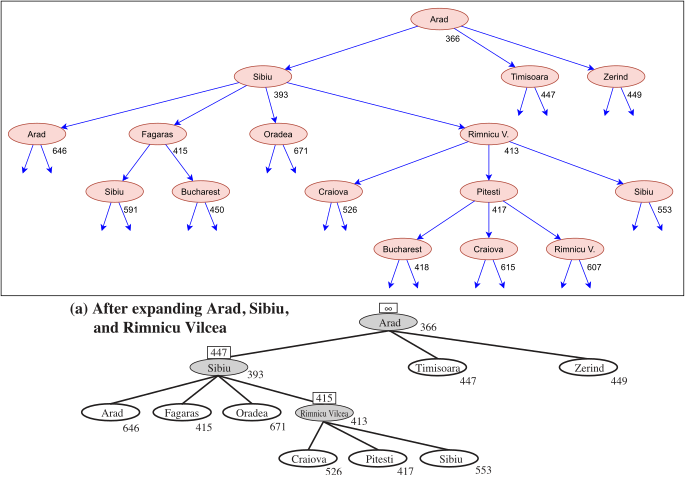
- The recursion unwinds and the best leaf value of the forgotten subtree (417) is backed up to Rimnicu Vilcea; then Fagaras is expanded, revealing a best leaf value of 450.
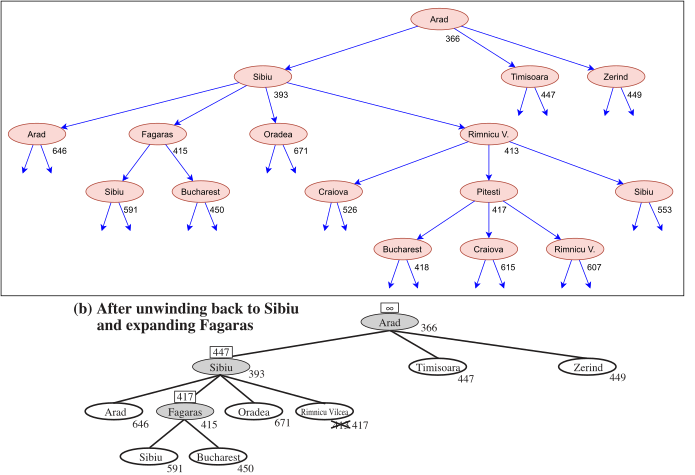
- The recursion unwinds and the best leaf value of the forgotten subtree (450) is backed up to Fagaras; then Rimnicu Vilcea is expanded. This time, because the best alternative path (through Timisoara) costs at least 447, the expansion continues to Bucharest.
Properties
- Optimality:
- Like A*, optimal if h(n) is admissible.
- Time complexity:
- Difficult to characterize.
- Depends on accuracy of h(n) and how often the best path changes.
- Can end up “switching” back and forth.
- Space complexity:
- Linear space: O(bd).
- Other extreme to A* - uses too little memory even if more memory were available.
Simplified Memory-bound A* – SMA*
- Similar to A*, but deletes the worst node (largest f-value) when memory is full.
- SMA* expands the (newest) best leaf and deletes the (oldest) worst leaf.
- SMA* also backs up the value of the forgotten node to its parent.
- If there is a tie (equal f-values), delete the oldest nodes first.
- Simplified-MA* finds the optimal reachable solution given the memory constraint.
- The depth of the shallowest goal node is less than the memory size (expressed in nodes).
- Time can still be exponential.
Algorithm
function SMA*(problem) returns solution or failure

    node ← Make-Node(problem.Initial-State)
    node.f ← node.g + node.h
    frontier ← priority queue ordered by lowest f

    Insert(node, frontier)

    loop
        if frontier is empty then return failure

        node ← Pop(frontier)

        if Goal-Test(node.State) then return Solution(node)

        if node is not fully expanded then
            s ← Next-Successor(node)
            s.f ← max(s.g + s.h, node.f)
            Insert(s, frontier)
        else
            node.f ← min(child.f for each child of node)
            if node is not root then
                Insert(node.parent, frontier)

        if memory is full then
            worst ← Shallowest-Highest-f leaf in frontier
            Remove(worst, frontier)
            parent ← worst.parent
            Remove worst from parent.children
            parent.f ← min(child.f for each child)
            Insert(parent, frontier)
Illustration
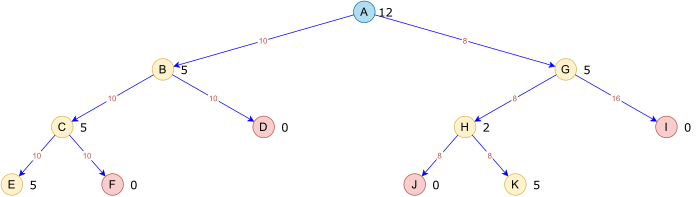
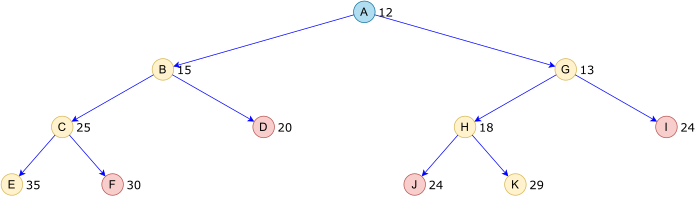
Find the lowest-cost goal node with enough memory:
- Max Nodes = 3.
- A: start node and D, F, I, J: goal nodes.
- Each edge/node is labelled with its step cost/heuristic value.
Consider only current f-cost:
Learning to search better
- Could an agent learn how to search better? Yes.
- Metalevel state space: Each state captures the internal (computational) state of a program that is searching in an object-level state space.
- A metalevel learning algorithm learns from these experiences to avoid exploring unpromising subtrees.
- For example, the map of Romania problem:
- The internal state of the A* algorithm is the current search tree.
- Each action in the metalevel state space is a computation step that alters the internal state; for example, each computation step in A* expands a leaf node and adds its successors to the tree.
5.5 Heuristic functions
The effect of heuristic accuracy on performance
- Effective branching factor b^{*} characterizes the quality of a heuristic.
- If the total number of nodes generated by A* for a particular problem is N and the solution depth is d, then b^{*} is the branching factor that a uniform tree of depth d would have to have in order to contain N+1 nodes: N+1=1+\left(b^{*}\right)+\left(b^{*}\right)^{2}+...+\left(b^{*}\right)^{d}
- b^{*} varies across problem instances, but is fairly constant for sufficiently hard problems.
- A well-designed heuristic would have a value of b^{*} close to 1 \Rightarrow fairly large problems solved at reasonable cost.
| d | IDS | A*(h_{1}) | A*(h_{2}) | IDS | A*(h_{1}) | A*(h_{2}) |
|---|---|---|---|---|---|---|
| 2 | 10 | 6 | 6 | 2.45 | 1.79 | 1.79 |
| 4 | 112 | 13 | 12 | 2.87 | 1.48 | 1.45 |
| 6 | 680 | 20 | 18 | 2.73 | 1.34 | 1.30 |
| 8 | 6384 | 39 | 25 | 2.80 | 1.33 | 1.24 |
| 10 | 47127 | 93 | 39 | 2.79 | 1.38 | 1.22 |
| 12 | 3644035 | 227 | 73 | 2.78 | 1.42 | 1.24 |
| 14 | – | 539 | 113 | – | 1.44 | 1.23 |
| 16 | – | 1301 | 211 | – | 1.45 | 1.25 |
| 18 | – | 3056 | 363 | – | 1.46 | 1.26 |
| 20 | – | 7276 | 676 | – | 1.47 | 1.27 |
| 22 | – | 18094 | 1219 | – | 1.48 | 1.28 |
| 24 | – | 39135 | 1641 | – | 1.48 | 1.26 |
Dominance and Composite
- If h_{2}(n)\geq h_{1}(n) for all n (both admissible), then h_{2} dominates h_{1} and is better for search.
- A* using h_{2} will never expand more nodes than A* using h_{1}.
- Hence, it is generally better to use a heuristic function with higher values, provided it is consistent and that the computation time for the heuristic is not too long.
- Suppose a collection of admissible heuristics {h_{1},...,h_{m}} is available for a problem and none of them dominates any of the others.
- The composite heuristic function is defined as h(n)=\max\{h_{1}(n),...,h_{m}(n)\}. It is consistent and dominates all component heuristics.
Relaxed problems
Definition
A problem with fewer restrictions on the actions is called a relaxed problem.
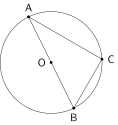
Prove that the angle in a semicircle is a right angle.
Generating admissible heuristics from relaxed problems
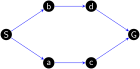
The state-space graph of the relaxed problem is a supergraph of the original state space because the removal of restrictions creates added edges in the graph.
Original problem state-space:
Relaxed problem state-space:
Hence, the cost of an optimal solution to a relaxed problem is an admissible heuristic for the original problem.
Furthermore, because the derived heuristic is an exact cost for the relaxed problem, it must obey the triangle inequality and is therefore consistent.
Original problem of 8 puzzle
A tile can move from square A to square B if A is horizontally or vertically adjacent to B and B is blank.
We can generate three relaxed problems by removing one or both of the conditions:
Relaxed problems
- A tile can move from square A to square B if A is adjacent to B \to h_{2}.
- A tile can move from square A to square B if B is blank \to exercise.
- A tile can move from square A to square B \to h_{1}.
Generating admissible heuristics from subproblems
- Admissible heuristics can also be derived from the solution cost of a subproblem of a given problem.
- The cost of the optimal solution of this subproblem \leq the cost of the original problem (lower bound).
- It can be more accurate than Manhattan distance in some cases.
- A subproblem of the 8-puzzle instance. The task is to get tiles 1, 2, 3, and 4 into their correct positions, without worrying about what happens to the other tiles.
Goal fixed?
Assume that the goal state G is fixed:
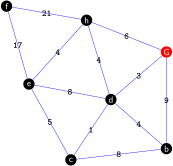
Using to find the shortest path from G to the other states:
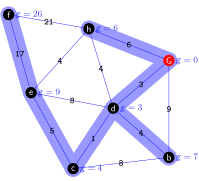
The final g values can be considered as optimal h^{\ast} values:
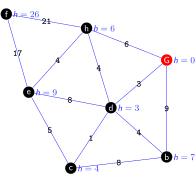
Pattern databases
- Pattern databases (PDB) store the exact solution costs for every possible subproblem instance.
- E.g., every possible configuration of the four tiles and the blank.
- The database itself is constructed by searching back from the goal and recording the cost of each new pattern encountered; the expense of this search is amortized over many subsequent problem instances.
- The complete heuristic is constructed using the patterns in the databases.
Computing the Heuristic
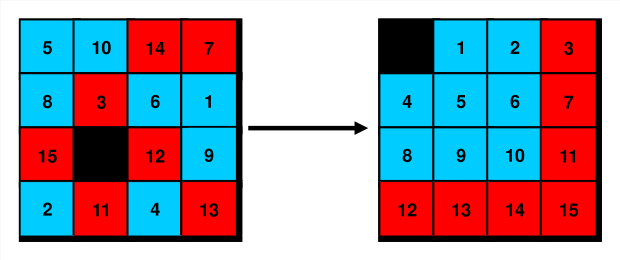
- 31 moves needed to solve red tiles.
- 22 moves need to solve blue tiles.
- Overall heuristic is maximum of 31=\max(31,22) moves.
Disjoint pattern databases
- Limitation of traditional PDB: Taking the max \to diminishing returns on additional PDBs.
- Disjoint pattern databases: Count only moves of the pattern tiles, ignoring non-pattern moves.
- If no tile belongs to more than one pattern, add their heuristic values.
Computing the Heuristic
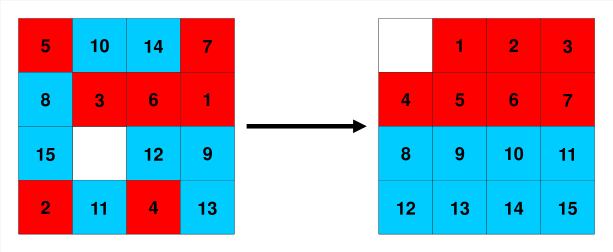
- 20 moves needed to solve red tiles.
- 25 moves needed to solve blue tiles.
- Overall heuristic is sum, or 45=20+25 moves.
Performance
- 15 Puzzle
- 1000 \times speedup vs. Manhattan distance.
- IDA* with the two DBs (the 7-tile database contains 58 million entries and the 8-tile database contains 519 million entries) solves 15-puzzles optimally in 30 milliseconds.
- 24 Puzzle
- 12 million \times speedup vs. Manhattan distance.
- IDA* can solve random instances in 2 days.
- Requires 4 DBs (each DB has 128 million entries).
- Without PDBs: 65,000 years.
Learning heuristics from experience
- Experience means solving a lot of instances of a problem.
- E.g., solving lots of 8-puzzles.
- Each optimal solution to a problem instance provides examples from which h(n) can be learned.
- Learning algorithms:
- Neural nets
- Decision trees
- Inductive learning